Best Pool Test Kits & Testers (2026)
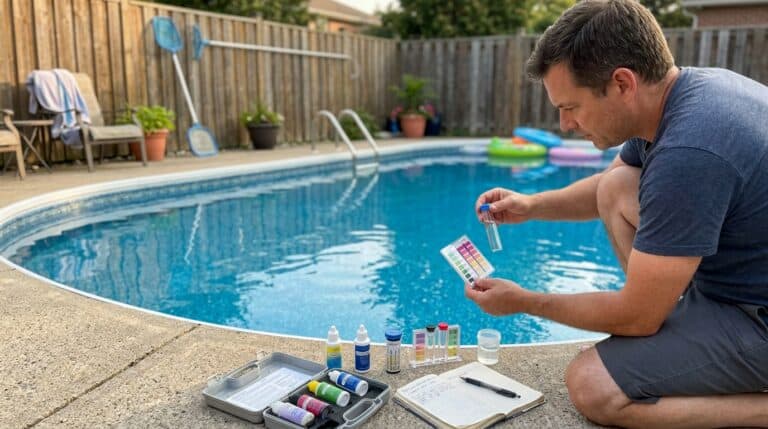
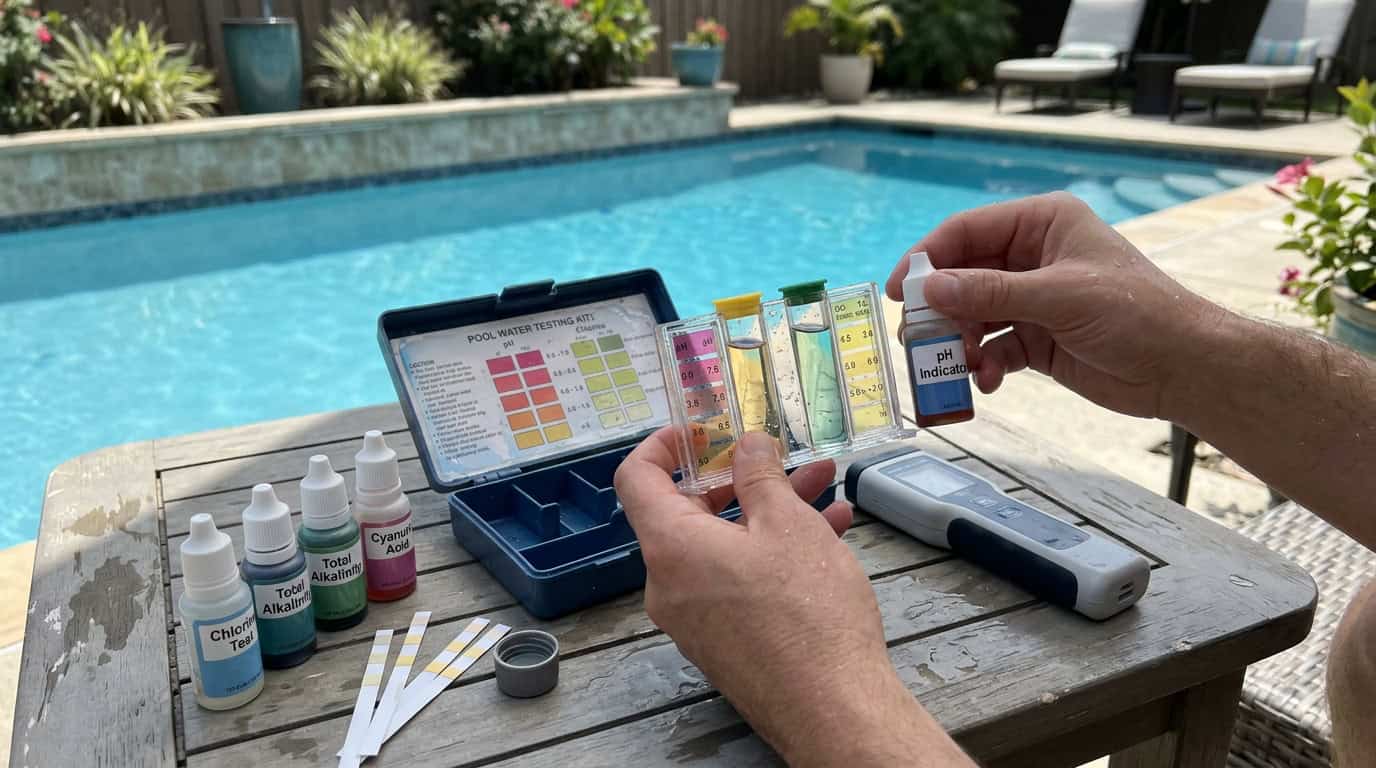
Which pool test kit you actually need comes down to one question most buying guides skip: how much accuracy do you need, and how much color-matching guesswork are you willing to do to get it? Test strips, liquid drop kits, and digital photometers all measure the same water chemistry, but they trade off speed, cost, and precision very differently. We cover the full testing process in our complete guide to testing pool water at home; this guide focuses specifically on which kit to buy for your situation.
Match the Kit to How You Actually Test
If you test twice a week for routine free chlorine and pH checks, a strip is genuinely enough, dragging out a drop kit every time is overkill. If you’re troubleshooting a persistent imbalance, verifying results after shock treatment, or you’re colorblind and struggle with color-chart comparisons, step up to a liquid drop kit or a digital tester. Saltwater pools need one additional thing standard kits don’t cover: a salt-specific reading.
Quick Comparison
| Product | Type | Parameters Tested | Best For |
|---|---|---|---|
| AquaChek 7-Way Test Strips | Test strips | pH, total chlorine, free chlorine, bromine, alkalinity, hardness, CYA | Best Budget / Routine Testing |
| AquaChek TruTest Digital Reader | Strip + digital reader | Free chlorine, bromine, pH, total alkalinity | Best Strip-to-Digital Hybrid |
| Taylor K-2005 | Liquid drop kit | FC, TC, bromine, pH, acid/base demand, TA, CH, CYA | Best Overall / Most Accurate |
| LaMotte ColorQ Pro 7 | Digital photometer | FC, TC, bromine, pH, alkalinity, hardness, CYA | Best Digital / Colorblind-Accessible |
| Solaxx SafeDip | Digital meter | Salt, pH, free chlorine, ORP, TDS, temperature | Best for Saltwater Pools |
1. AquaChek 7-Way Pool and Spa Test Strips – Best Budget / Routine Testing
No products found.100 strips covering pH, total chlorine, free chlorine, bromine, alkalinity, total hardness, and cyanuric acid in a single 15-second dip. This is the fastest, cheapest way to keep tabs on routine chemistry between more precise checks, and AquaChek has been a trusted name in this category for over 35 years.
Pros: Fastest testing method available (about 15-20 seconds); covers 7 parameters in one dip; inexpensive enough to test frequently without worrying about cost per test; no reagents to spill or count.
Cons: Accuracy is roughly ±20-30%, adequate for routine monitoring but not precise enough for diagnosing a persistent imbalance; color-chart comparison is unreliable for colorblind users; strips degrade if stored improperly (humidity and UV both pre-react the pads).
Why customers choose this: for the large majority of pool owners doing routine twice-weekly checks, this is genuinely all the precision you need, and at this price it’s easy to test more often rather than skipping checks to save money.
2. AquaChek TruTest Digital Test Strip Reader – Best Strip-to-Digital Hybrid
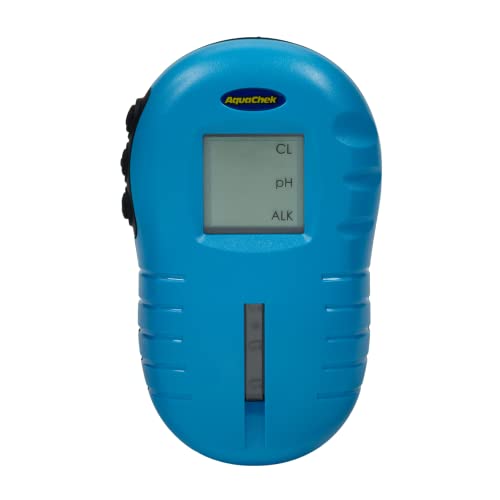
Combines the speed of test strips with a digital readout, removing color interpretation from the equation entirely. Dip the included TruTest strip, insert it into the reader, and get a numeric result in about 15 seconds instead of matching colors on a chart. Includes 25 strips to start.
Pros: No color matching required, genuinely useful for colorblind users; keeps the speed advantage of strip testing; simple three-step process (dip, insert, read).
Cons: Only works with proprietary TruTest strips, not standard AquaChek strips, so refills cost more than generic strips; tests fewer parameters (4) than a full 7-way strip; still a strip-based method underneath, so it inherits some of the same accuracy limitations as strips generally.
Why customers choose this: for anyone who’s struggled with color-matching accuracy on standard strips, this solves that problem directly without the cost or complexity of a full liquid drop kit.
3. Taylor K-2005 Complete Pool Test Kit – Best Overall / Most Accurate
No products found.The standard comprehensive liquid drop kit, and the one most pool professionals actually use. Tests free and total chlorine, bromine, pH, acid/base demand, total alkalinity, calcium hardness, and cyanuric acid using DPD reagent chemistry, accurate to roughly ±5-10%, meaningfully tighter than any strip. Taylor has made water testing equipment since 1930, entirely in the USA.
Pros: Significantly more accurate than test strips; comprehensive 9-parameter coverage in one kit; reagents and comparator are built to last multiple seasons with proper storage; the professional standard for a reason.
Cons: Takes 5-10 minutes per full test versus 15-30 seconds for a strip; requires careful technique (vertical dropper, accurate drop counting) to get accurate results; reagents degrade with heat and UV exposure and need annual replacement regardless of how much remains.
Why customers choose this: when a strip result looks off, or you’re trying to diagnose a stubborn imbalance, this is the kit that gives you a number worth trusting. Many owners keep both a strip pack for daily checks and this kit for the weekly deeper test.
4. LaMotte ColorQ Pro 7 Digital Pool Water Test Kit – Best Digital / Colorblind-Accessible
No products found.A handheld photometer that removes color interpretation entirely, a light sensor measures how much light passes through the treated sample and converts that to a direct numeric reading for free chlorine, total chlorine, bromine, pH, alkalinity, calcium hardness, and cyanuric acid. This is the digital tester our companion testing guide specifically calls out as the accessible option for colorblind users.
Pros: Removes color-matching entirely, the most genuinely accessible option for colorblind users; accuracy in the ±1-5% range, tighter than strips or standard drop-kit color comparison; digital display eliminates subjective reading error.
Cons: The highest upfront cost of any option in this guide; still requires reagents (liquid or tablet) that need restocking; sensor needs periodic care and the unit itself is a more delicate piece of equipment than a strip or a comparator tube.
Why customers choose this: for anyone who wants drop-kit-level accuracy without the color interpretation step, or specifically needs a colorblind-accessible option, this is the clearest solution available.
5. Solaxx SafeDip Digital Test Meter – Best for Saltwater Pools

The one kit in this guide built specifically around what standard chlorine-pool test kits miss: salt concentration. The SafeDip reads salt, pH, free chlorine, ORP, TDS, and water temperature by dipping the sensor and pressing start, no reagents to buy or count. Since salt chlorine generators need a specific salinity range to work efficiently, this fills a real gap that a standard strip or drop kit doesn’t cover at all.
Pros: The only kit here with a genuine salt reading, essential for SWG pool owners; no ongoing reagent costs; measures ORP directly, useful for verifying sanitizer activity independent of a ppm chlorine reading.
Cons: Requires periodic calibration with buffer tablets (sold separately) to stay accurate; some buyers report the sensor or display degrading faster than expected, worth treating as a tool that needs reasonably careful handling rather than a rugged all-weather device; doesn’t test total alkalinity, calcium hardness, or cyanuric acid, so SWG pool owners still need a strip or drop kit alongside it for full chemistry coverage.
Why customers choose this: if you have a saltwater pool, this is the one purpose-built tool in this guide for the parameter your SWG system actually depends on.
Frequently Asked Questions
Are test strips accurate enough for pool maintenance?
For routine monitoring, yes. Strips run roughly ±20-30% accuracy, which is fine for catching major swings in free chlorine and pH before they become a problem. For diagnosing a persistent imbalance or verifying results after shock treatment, step up to a liquid drop kit or digital tester.
Do I need a separate salt tester for a saltwater pool?
Yes. Standard test strips and drop kits don’t measure salt concentration at all, and salt chlorine generators need salinity in a specific range (typically 3,000-4,000 ppm, check your SWG manual) to function correctly. A dedicated salt tester like the Solaxx SafeDip covers this alongside a standard kit for the rest of your chemistry.
What’s the most accurate home pool test method?
A properly calibrated digital photometer (like the LaMotte ColorQ Pro 7) is the most accurate home option, in the ±1-5% range. A liquid drop kit using FAS-DPD titration for chlorine is a close second and is what most professional pool technicians actually carry.
Can I just use one test kit for everything?
For most pools, a liquid drop kit like the Taylor K-2005 covers routine and diagnostic testing in one kit. Many owners still keep a cheap strip pack on hand for quick daily checks between the more thorough weekly drop-kit test, since strips are faster for a simple go/no-go read.
Bottom Line
Strips for routine checks, a drop kit or digital tester when you need real accuracy, and a dedicated salt tester if you’re running a saltwater system, that’s the whole decision tree. Most pool owners end up with two of these: a cheap strip pack for quick daily reads, and either the Taylor K-2005 or the LaMotte ColorQ Pro 7 for the weekly test that actually needs to be trusted. For the full testing process, from sample collection through reading results, see our complete pool water testing guide.