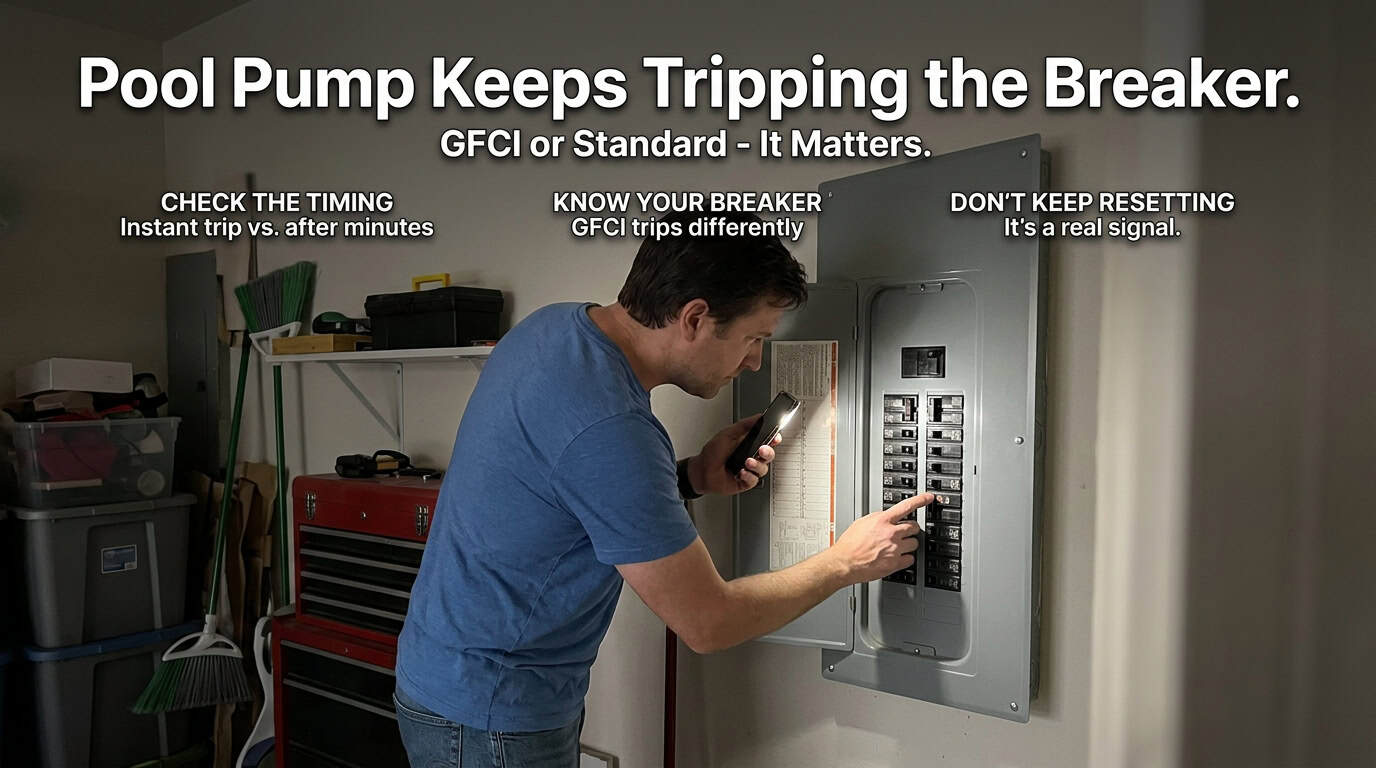
Pool Pump Keeps Tripping the Breaker
A pool pump tripping a breaker is not something to reset and ignore. It’s mechanical and electrical equipment sitting near water, and a breaker that keeps tripping is telling you something real is wrong, either the pump is drawing too much current, or current is leaking somewhere it shouldn’t. The fix depends entirely on which type of breaker you have and when the trip actually happens.
GFCI vs. Standard Breaker – They Trip for Different Reasons
This distinction matters more than most troubleshooting guides make clear. A standard breaker trips when the circuit draws more current than it’s rated for, an overload. A GFCI (ground-fault circuit interrupter) trips when it senses current leaking to ground instead of returning cleanly through the circuit, which can indicate a shock hazard even if the pump isn’t technically overloaded. Most pool pump circuits use a GFCI specifically because the equipment sits near water. Knowing which one you have narrows the list of likely causes considerably.
Timing Tells You a Lot
Before diagnosing anything else, note exactly when the trip happens:
- Trips instantly on startup: often points to a short, a bad motor winding, a failed capacitor, or a locked/jammed impeller.
- Runs fine, then trips after several minutes: usually overheating, a restriction forcing the motor to work harder than it should, or the motor pulling excess amps as it runs.
- Only trips after rain: strongly suggests moisture intrusion somewhere, the conduit, a junction box, the timer, or the breaker itself.
If It’s a GFCI Trip
A GFCI trip almost always means current is leaking to ground. The most common real causes, in rough order of likelihood:
- Moisture inside the motor. Damp or humid conditions around pool equipment, combined with chlorine residue, corrode wire terminals and gradually break down motor seals and winding insulation over time. This is often the slow background reason a circuit that ran fine for years suddenly starts tripping.
- Degraded winding insulation on an older motor. A licensed electrician can test this directly with a megohmmeter, applying a voltage and measuring how much current leaks from the windings to the motor frame. A low reading confirms a wet or degraded motor before you spend money replacing the wrong part.
- A failing capacitor. Capacitors can develop internal faults that create a leakage path.
- A worn-out or faulty GFCI itself. GFCIs do wear out. If everything else tests clean, the breaker itself may be the problem.
- Wrong GFCI brand for a variable-speed pump. Some variable-speed pump motors produce electrical noise as they ramp up and down that certain GFCI brands read as a fault even when nothing is actually wrong. This is a documented, known issue on several VS pump models, and switching to the manufacturer-recommended GFCI brand (often specified in the pump’s manual) resolves it in many cases.
If It’s a Standard Breaker Trip
This points toward the pump physically working harder than it should:
- Jammed or locked impeller. Debris lodged in the impeller forces the motor to strain, pulling more current than the circuit allows.
- Worn motor bearings. A motor that has to fight worn bearings draws more current to keep spinning.
- Clogged basket or dirty filter restricting flow. The motor works harder against the restriction, which shows up as excess amp draw over time.
- Undersized circuit for the pump. If a pump was recently replaced with a higher-powered model, the existing circuit and breaker may simply be undersized for the new load.
What to Check Yourself, Safely
- Note the exact timing pattern (instant, after minutes, after rain) before doing anything else.
- With power off, check for visible debris in the pump basket and impeller area.
- Check whether the trips correlate with wet weather or high humidity.
- If you recently upgraded the pump, confirm the new motor’s rated amperage against the existing breaker’s rating.
- Try resetting once. If it trips again immediately, stop, this is not a keep-resetting-it situation.
When to Call an Electrician, Not Just a Pool Tech
A breaker that trips repeatedly, especially a GFCI, is a genuine safety signal, not a nuisance to bypass. Never replace a GFCI with a standard breaker to solve a tripping problem, that removes the exact protection installed because the equipment sits near water. If basic checks (debris, obvious moisture, an amperage mismatch) don’t resolve it, this is worth a licensed electrician’s time, especially anything involving suspected motor winding leakage or wiring in a wet environment.
Frequently Asked Questions
Why does my pool pump only trip the breaker after it rains?
This pattern strongly points to moisture reaching somewhere it shouldn’t, conduit, a junction box, the timer enclosure, or the breaker itself. Have the wiring path inspected for water intrusion rather than assuming it’s the pump motor.
Is it safe to just keep resetting the breaker?
No. Repeated resets without fixing the underlying cause risk motor damage from continued overload, or in the case of a GFCI trip, indicate an active leakage path near water that should be diagnosed, not worked around.
Can a clogged filter really cause a breaker to trip?
Yes. A badly clogged filter or basket restricts flow, forcing the pump motor to work harder and draw more current than normal, which can be enough to trip a standard breaker over time even without any electrical fault.
Bottom Line
Identify whether you have a GFCI or standard breaker and note exactly when the trip happens, that combination narrows the cause significantly before you touch anything. Simple mechanical causes (debris, a clogged basket) are safe to check yourself. Anything suggesting moisture in the motor or wiring, or a trip that recurs after a single reset, is worth a licensed electrician’s inspection rather than repeated resets. If your pump is due for replacement anyway, our above-ground pool pump guide or 15,000 gallon pool pump picks cover what to look for.